

 It is December 7, 1941, 6 Japanese aircraft carriers are secretly stationed 300 miles north of the U.S. naval base in Pearl Harbor. At 6am the carriers launch over 300 planes for an attack that would become America’s greatest naval defeat in history. Their mission? To destroy as many battleships and aircraft carriers as possible and to leave America helpless for the war to come. In the next 3 hours 2,400 Americans are killed and two/thirds of America’s navy are destroyed by Japanese planes.
 But Japan made a mistake that would come back to haunt them. Not one American Aircraft Carrier had been in Pearl Harbor during the raid, as Japan had planned, where they would have been destroyed along with everything else. I believe that aircraft carriers won World War II for America and that is why we are still a free nation today. Aircraft carriers are enormous ships that essentially operate as mobile air-force bases. They launch, land, and store aircraft while at the same time running just like a ship would. Let me tell you, first of all, what carriers have done for America, secondly, how carriers operate today, and last of all, how life is onboard.
So, what have carriers done for America? The very first U.S. aircraft carrier entered the navy in the early 20s’, two years after World War I was over. It had originally been a coal ship until it was converted and named the USS Langley.  The USS Langley was a new and big achievement at that time. Not only was it one of the very first carriers ever built, but it was longer, bigger, and could carry more planes than all the carriers previously made by other countries. The Langley’s flat top deck was 542 feet long, almost the length of two football fields put together, with which she could launch and land her 36 planes.
By the time World War II was just around the corner, 18 years later, carriers had doubled in size and could carry twice as many planes. America had 7 of them.

Then came the attack on Pearl Harbor.  Before attacking, the Japanese commander, Admiral Nagumo who controlled the operation, received a report that no carriers were in the harbor. Even though his most important targets were gone, he decided to attack, for fear his position would be discovered before the raid was carried out. This left America with 7 carriers all of which were used to hold Japan at bay.
4 months after Pearl Harbor, America was able to bomb Tokyo, Japan with planes from the carrier the USS Hornet. This enraged Japan so they quickly tried to invade an American base in Port Moresby, next to the Coral Sea. Carriers were there to stop them. The Battle of the Coral Sea was the first battle to be fought entirely by carriers. Then, with a large fleet, Japan again tried to invade an American island called Midway. Again they were stopped by carriers in a battle that proved to be a decisive turning point in World War II. Japan lost 4 of their own carriers and most of their best pilots, which left America with the upper hand. From then on carriers led the way for America invading base after base up to the last and largest naval battle of the war, the Battle of Leyte Gulf. This battle lasted for 3 days as Americans were trying to recapture the Philippines and the Japanese were trying to fight back. 282 ships fought and dodged while planes were swarming like flies. There were over 900 planes involved. By the end of the battle the Japanese fleet had virtually been destroyed. Carriers proved themselves to be more effective than any other ship during World War II and have ruled the seas ever since.


 It is
It is 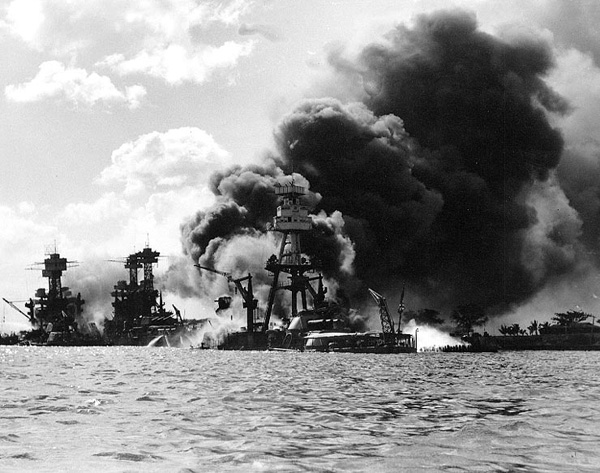

 The USS Langley was a new and big achievement at that time. Not only was it one of the very first carriers ever built, but it was longer, bigger, and could carry more planes than all the carriers previously made by other countries. The
 Before attacking, the Japanese commander, Admiral Nagumo who controlled the operation, received a report that no carriers were in the harbor. Even though his most important targets were gone, he decided to attack, for fear his position would be discovered before the raid was carried out. This left

.jpg)


